
Rule of thumb: stop touching the opener, keep people clear, and don't try to force the door back into alignment
A garage door is a 100- to 400-pound panel held up by springs under heavy tension and cables that can be just as dangerous when they let go. If it's come off its track, the thing holding it up may not be what you think it is anymore. The main exceptions to "just back away" are: if someone is physically under or in front of the door right now (get them clear first, don't worry about the door), or if the door is blocking a vehicle exit during an emergency and you genuinely cannot wait — in that case, treat it as a falling hazard and move the car around it rather than through the opening.
What actually goes wrong when a door jumps the track
There are a few different failure modes, and they are not equally serious:
- A single roller pops out of the track groove, usually from a worn roller, a track bent slightly inward, or debris (pine straw and leaf litter are common this time of year) jamming the channel. The door may still be mostly supported.
- The track itself is bent or pulled away from the wall bracket, often from an impact — a car bumper, a bike, a gust-driven branch during a fall storm. This changes the geometry the whole door depends on.
- A cable has snapped or frayed through, usually on one side. This is the dangerous one: the door loses support on that side and can tilt, twist, or drop without warning.
- A spring has failed while the door was in motion, which can yank the door sideways hard enough to pop it off the track entirely.
From the outside, you often can't tell which one you're dealing with, which is exactly why the next section matters.
The immediate steps, in order
- Stop operating the door. If it's mid-motion, don't hit the remote or wall button again. Repeated attempts can finish bending a track or snap a frayed cable the rest of the way.
- Clear the area. No one standing under the door, no one reaching in to "help" it back into the track, and keep vehicles out of the opening until it's been inspected.
- Leave the emergency release cord alone. It's tempting to pull it to put the door in manual mode, but if the door is unsupported on one side, releasing the trolley can let it fall instead of lift smoothly. Only use the release if you're certain the door is still structurally supported and you need to move it a few inches to get a vehicle out — and even then, go slowly and stop at the first resistance.
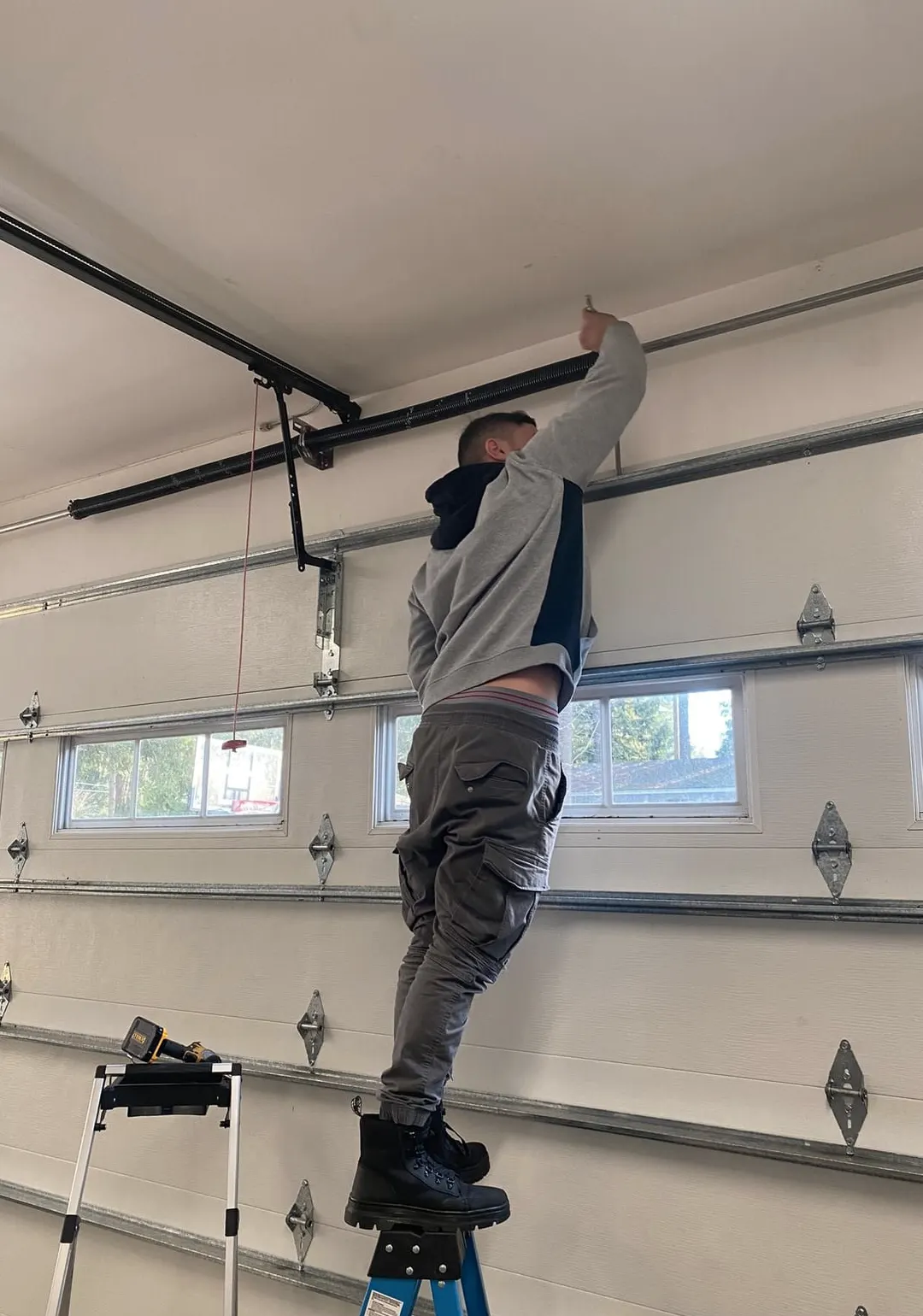
- Do a visual check only. Look for a visible gap in the torsion spring coil above the door, a cable hanging loose or frayed at either bottom corner, or a track pulled away from its wall brackets. Don't touch any of it. Note what you see so you can describe it when you call for help.
- If a cable or spring is clearly broken, treat the whole door as unsafe to pass under or operate in any way, including manually, until it's been secured.
- If it's just one roller out of the groove and the door is sitting level and still supported, it's a lower-risk situation, but it still needs a technician to re-seat it correctly and check for the wear or impact that caused it — forcing a roller back in by hand often just pushes it back out once the door cycles again.
Why this is more common heading into winter here
Metal tracks and rollers that spent the summer dealing with heavy humidity and the occasional hard rain don't always hold their alignment once the first real cold snap of the season hits. Metal contracts slightly in the cold, brackets that were already loosened by humidity swings can shift a little more, and rollers that picked up rust or grit over a wet summer become more brittle right as temperatures drop. Add in pine straw and leaf debris from fall drop-off settling into the track channel, and you've got a door that's more likely to bind, jump, or strain a cable than it was in July. None of that makes an off-track door less dangerous — it just explains why late fall is a season you'll see more of these calls.
When to call Alpharetta Garage Door
Any door off its track should be looked at the same day, not scheduled for "whenever." If it happened outside normal business hours and you can't safely leave the garage closed off, that's exactly what our Emergency Garage Door Service is for — we'll come assess whether the door is safe to leave as-is overnight or needs to be secured immediately. For the repair itself, our techs will determine whether you're looking at a simple roller re-seat, a bent track section that needs replacing, or a cable or spring issue that requires the door to be brought back under control before anything else happens — that's standard Garage Door Repair work, and if a torsion or extension spring turns out to be the root cause, that gets handled as a full Spring Replacement rather than a patch job, since a spring that failed once under normal use isn't one you want to trust again.
If your garage door has jumped the track anywhere in Alpharetta, Roswell, Milton, Johns Creek, Cumming, Duluth, Suwanee, or Woodstock, don't try to wrestle it back into place. Call Alpharetta Garage Door and we'll get a technician out to secure it safely and get it running the way it should.