
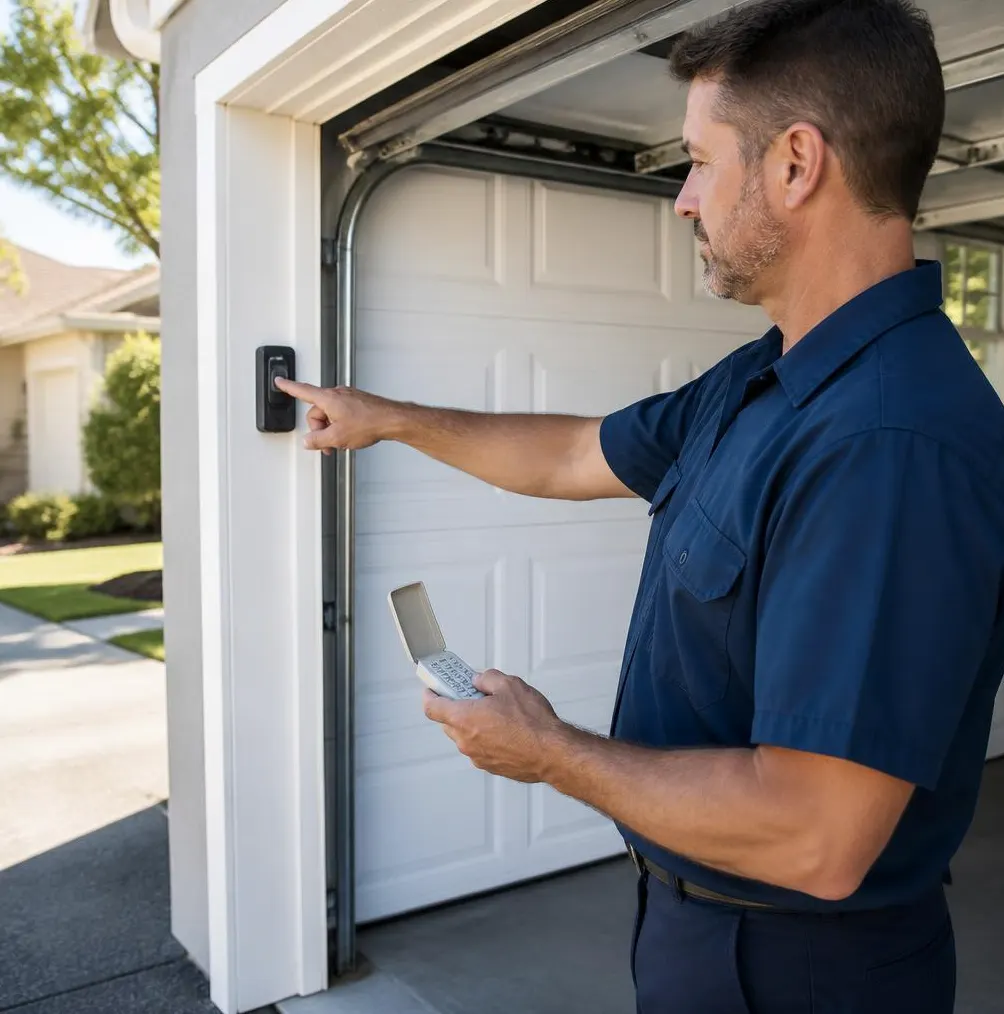
As a rule of thumb, if the door won't open, the problem is almost always power, a safety sensor, or a spring — rarely the opener itself. The exceptions are homes with older openers past the ten-year mark, where worn gears and stripped sprockets become more likely, and homes where someone recently worked in the garage and may have bumped the manual release cord or left the vacation lock switched on.
What the Symptom Tells You Before You Even Open the Panel
How the door fails is the first clue. A completely silent opener (no light, no hum) points to power. A motor that hums or clicks but the door doesn't move points to the drive mechanism or a disconnected trolley. A door that opens a few inches and reverses points to sensors or limit settings. A door that won't budge even when you pull the manual release and lift by hand points to a broken spring or snapped cable — and that one is not a DIY fix.
The Order a Technician Checks Things
1. Power to the Opener
First check is always the simplest: is the opener actually getting power? Garage outlets are frequently on a GFCI circuit, and in a North Fulton fall with heavy rain and condensation in unheated garages, GFCI outlets trip more often than people expect. A technician checks the outlet, the breaker panel, and whether the opener's own light turns on at all. The fix here is a reset button and five minutes, not a service call — which is exactly why it's checked first.
2. Remote, Wall Button, and Battery Backup
Next is confirming whether the problem is the opener or just the remote. A dead remote battery or a wall button with a frayed low-voltage wire will make it look like the whole system failed. If the opener has battery backup and the backup battery has died, that can also cause intermittent failures during power blips, which aren't rare here after a hard storm.
3. Safety Sensors (Photo Eyes)
If the opener runs but the door won't close, or closes and immediately reverses, the photo-eye sensors near the floor are the next check. Cold mornings bring condensation inside the lenses, and dirt, cobwebs, or a nudged bracket can knock them out of alignment just enough to block the signal. A tech checks for a solid light on both sensors, wipes the lenses, and resets alignment — this is a quick fix, not a parts replacement.
4. Manual Release and Vacation Lock
Before touching anything mechanical, a technician confirms the trolley is actually engaged with the opener carriage. If someone pulled the red emergency release cord — intentionally or by accident — the door disconnects from the opener and will not respond to any remote or wall button until it's manually reconnected. Some openers also have a vacation lock switch that disables remotes entirely; it gets flipped by accident more often than homeowners admit.
5. Springs
If the opener has power, the sensors are clear, and the door is still dead weight, the spring gets inspected. A visible gap in a torsion spring, or a door that feels unusually heavy when lifted by hand with the opener disconnected, confirms it. This is the point where DIY stops — torsion springs are under enough tension to cause serious injury, and replacement means matching the correct wire size and winding the new spring to the right tension with the right tools.
6. Cables and Pulleys
A frayed or jumped cable often shows up alongside a spring issue, especially on older doors or ones that have taken on moisture around the bottom bracket. A cable off its drum will usually cause the door to hang crooked on one side rather than refusing to move entirely, which helps a technician tell it apart from a spring failure at a glance.
7. Opener Gears, Belt, or Chain
If everything upstream checks out but the motor just hums without moving the door, the internal drive gear, belt, or chain gets inspected. Stripped nylon gears are common in openers that are eight to twelve years old, and a loose chain or belt can slip off its track entirely. Gear replacement is usually more cost-effective than the time it takes to source and fit it; a full opener swap is often the more practical call once a unit hits that age.
8. Track Obstructions and Rollers
Last on the list because it's the least common full-stop cause: a track pinched by moisture-swollen wood framing, a roller seized from rust after a wet season, or debris — pine needles, a stray tool — wedged where the door can't pass. A visual walk of both tracks usually finds it fast.
When to Call Alpharetta Garage Door
If the reset button, remote batteries, and a wipe of the sensor lenses don't bring the door back, stop troubleshooting past that point — especially if the door feels heavy or won't lift manually. That's the line between a homeowner fix and a job for Garage Door Repair, and if a spring has let go, our Spring Replacement service handles it with the right tools and the correct tension specs for your door. A fully dead door on a weekend or holiday is also exactly what our Emergency Garage Door Service exists for — a door that won't open isn't just inconvenient, it's a security gap until it's fixed.
If your garage door in Alpharetta, Roswell, Milton, Johns Creek, Cumming, Duluth, Suwanee, or Woodstock won't open, call Alpharetta Garage Door and we'll run this exact checklist in person, same day where possible.