
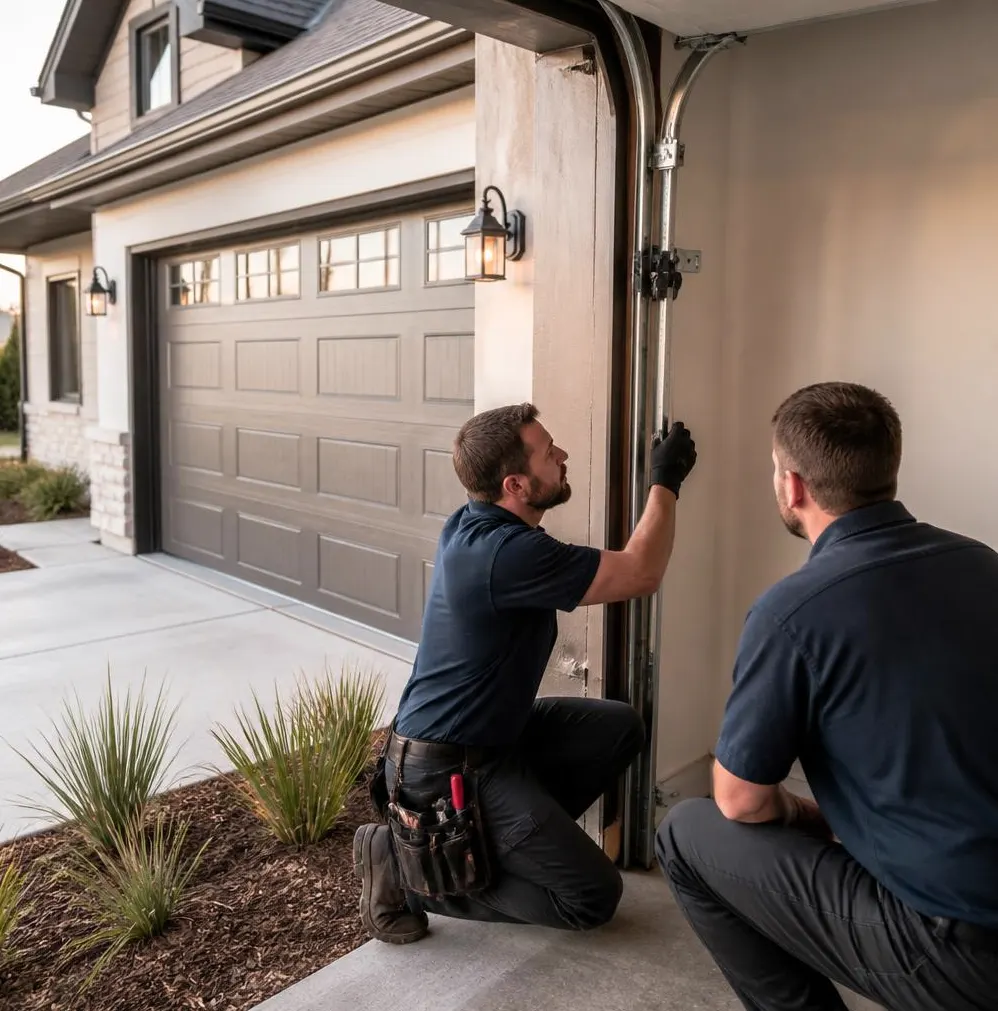
You Hear It Before You See It
It usually starts as a sound. You hit the opener button and instead of the smooth roll you're used to, there's a scrape, a grind, or a metallic shudder somewhere along the wall. Maybe the door jerks at one spot every single time, like it's catching on something. You walk over, look up at the tracks running along the ceiling and down the sides, and notice one side isn't quite lined up with the other. Or there's a visible gap where the roller has pulled away from the metal. Sometimes the door simply won't close flush anymore, leaving a sliver of daylight at the bottom corner.
This is what a bent or misaligned track looks like from the homeowner's side. It doesn't usually fail all at once. It creeps up over weeks, and by the time you notice the sound, the door has probably been fighting the track for a while.
What a Bad Track Does to the Rest of the Door
The track is the rail that guides the rollers as the door travels up and down. When it's even slightly out of alignment, the rollers bind instead of rolling freely, which puts extra strain on the opener motor, the cables, and the springs. Left alone, a misaligned track can cause a roller to jump out entirely, which can drop the door unevenly or jam it halfway open. It also accelerates wear on everything else, since the opener has to work harder to push a door that's rubbing metal on metal.
How a Technician Checks the Cause
1. Loose or Rusted Mounting Hardware
The first thing a tech checks is the hardware holding the track to the wall and header. Tracks are bolted to brackets, and brackets are screwed into the frame. Vibration from daily opening and closing gradually works these fasteners loose. In this area, humid summers and heavy rain add rust to that process, especially on garages that don't get much airflow or sit close to pine trees where moisture lingers on the metal longer. A loose bracket lets the track flex every time the door passes, and that flex is often the scraping sound you're hearing. The fix here is straightforward: re-tightening or replacing the bolts, and swapping any rusted brackets before they fail completely.
2. Physical Impact
Next, the tech looks for a dent or bend from something hitting the track directly. This is one of the most common causes, and it's rarely dramatic. A bike handlebar, a ladder, a car bumper backing in a little too far, or a lawnmower clipping the bottom section can all tweak the track just enough to throw off the roller path. Minor bends can sometimes be worked back into shape with a rubber mallet and a level, checked against a straightedge until the rail runs true again. If the bend is sharp or the metal has kinked, that section of track gets replaced rather than reshaped, since a track that's been forced back into place once tends to weaken over time.
3. Worn or Damaged Rollers
If the track itself looks straight, the next suspect is the rollers. Old steel rollers or ones with hardened, cracked nylon don't sit in the track evenly anymore, and the uneven friction can look like a track problem even when the rail is fine. The tech will spin each roller by hand to check for play, flat spots, or grinding. Replacing a full set of rollers is a relatively small job and often solves noise issues that homeowners assume require a full track replacement.
4. The Wood Jamb Behind the Track
If the hardware is tight and the rollers are fine, the next check is the jamb the track is actually bolted to. Wood expands and contracts with humidity, and the swing between a soaked summer and a dry stretch after an ice storm can be enough to shift a jamb slightly over a season or two. When the wood moves, the track mounted to it moves with it, even if the track itself was never damaged. This is more common in garages where the framing has had years of moisture exposure from heavy rain runoff or poor drainage near the slab. The fix usually involves shimming the jamb back to true, re-securing the track to solid wood, and sometimes addressing the moisture source so the problem doesn't repeat.
5. Door or Spring Imbalance
Last on the list, because it's the least obvious, is an imbalance somewhere else in the system. A weak or broken spring on one side can cause the door to hang slightly crooked as it travels, which puts sideways pressure on the track even when the track itself is in good shape. A tech checks this by disconnecting the opener and manually testing how the door balances at different points along its travel. If this is the root cause, the track fix is really a spring fix, and tightening or realigning the track alone won't hold for long.
When to Call Alpharetta Garage Door
If your door is scraping, hesitating, or sitting crooked in the opening, it's worth getting it looked at before a roller jumps the track entirely, which can turn a simple adjustment into a stuck door and a same-day scramble. Alpharetta Garage Door handles both garage door repair and garage door maintenance calls for exactly this kind of issue, checking hardware, rollers, jamb condition, and spring balance in the same visit so the real cause gets fixed instead of just the symptom. If the door won't move at all or is stuck partway open, that falls under emergency garage door service, and it's not something to force by hand.
If you're hearing that scrape every time the door opens, call Alpharetta Garage Door and get it checked before the next heavy rain or cold snap puts more stress on it. We serve Alpharetta, Roswell, Milton, Johns Creek, Cumming, Duluth, Suwanee, and Woodstock, and we'll have a technician out to track down the real problem.